As I turn 50 and reflect on the journey so far, I’ve found myself thinking more deeply about the role of business in our lives. Not just in mine, but in the lives of our teams, our clients, our communities. This piece is about a realisation I came to: that business, like money, is something we’ve made up. And because it’s made up, we can redesign it. We can choose to build businesses that prioritise people and relationships, not just profit. That’s what The Monergy Flow is about. It’s a model developed over the years—through failure, coaching, learning and curiosity—that helps align money, purpose and human connection. I’m sharing it here in the hope it gives you something useful to think about as you build your own version of a better business, and maybe, a better world too.
The Business That (Almost) Failed
As a teenager, I moved to London to start my very first business - a personal training company called JMHfitness. I was young, fit, confident, and like many young men, I believed I could conquer the world - or at the very least, dominate the personal training market in London.
The reality? A complete disaster.
I had no idea what I was doing in business. The “business strategy” I was taught on my personal education course, which mostly involved leaflet drops, didn’t work. I had the worst business in London. I struggled for years, barely scraping by. I couldn’t win clients. I wasn’t making enough money to survive. And then, the universe gave me a gift.
That gift came in the form of a new client, who happened to be a business coach - a man named Les Hercules Kalas. I had never heard of business coaching before. I thought the idea was ridiculous. Businesses need coaching?! What a joke.
But Les became my client. We trained twice a week, either in his garden or in Richmond Park. For about a year, I put him through workouts, completely unaware that he was about to change my life. Then, one day, I turned up at his house, ready for training. But something was different. Les wasn’t in his shorts and T-shirt.
Instead of working out, he said: “Come in. We’re going to have a chat.” Panic hit me. I thought I was getting fired. Les sat me down and said three things:
- “John, I like you. You’re a nice guy.”
- “I think you’re a decent personal trainer.”
- “You’re terrible at running a business.”
Then he made me an offer: “Please give me free personal training, so I can give you free business coaching.”
At first, I hesitated. I needed the money. But something about Les intrigued me. So I agreed. That was the moment my life changed forever.
The Lessons That Transformed Everything
Les taught me two things immediately:
- Measure what’s happening in your business, and use those measurements to make better decisions. Stop guessing. Stop relying on emotions.
- Business is all about people, relationships and human connections.
Within a year, JMHfitness had two full-time staff and more clients than we could handle. I remember feeling so proud that I had built something that was sustaining me, my staff and improving the lives of my clients. And the craziest part? It all came from an idea in my head.
What an incredible invention the Limited Liability Company is. A multi-win system that allows people to come together, improve each other’s lives and achieve profitable growth for all. That realisation obsessed me. I wanted to understand how this was happening all over the world. I consumed all I could about the ideas in and around this topic.
And all these years later? Les is still my business coach.
The Grand Illusion of Reality
I’ve always been inquisitive. And this thing - this creation - the LLC fascinated me.
People would talk about JMHfitness as if it were a real thing. I wanted to take care of it. My staff - actually, its staff, because technically JMHfitness employed them - wanted it to succeed, because it gave them something in return. It had its own bank account, brand, website and even merchandise. It had contracts, obligations and even a reputation. It got blamed for things from time to time too! It was treated like a living, breathing entity. People had a relationship with JMHfitness.
Yet, a few years earlier, it didn’t exist. In fact, in any real sense, it never existed. Not like you or I exist. Not like trees, stones or people exist. It was completely made up, and yet people believed in it. That’s incredible when you think about it.
And it’s not just businesses that float along on a tide of collective trust and belief.
Other things we assume to be real are, at their core, simply made up. Take money, for example. There was a time when money didn’t exist, and now it does. Not only that, but it has become an unquestioned part of human life. No matter where you are in the world, the people around you believe in money. A small, printed piece of paper with a particular set of writing and images on it has value - not because it inherently does, but because we collectively agree that it does.
“We believe money exists because we believe money exists.”
That sentence might sound strange at first, but think about it. The only reason money functions is that the shopkeeper you hand it to believes it exists. And the only reason he or she believes in it is because the bank teller who receives it in the morning also believes in it. Have you ever met someone who doesn’t believe in money? It’s an enormous, collective imagining that allows modern life to function.
And it’s not just money. Time, laws, nations, businesses - they all exist because we choose to believe in them. A border between two countries is just a concept until enough people agree that it separates one nation from another. Laws are just words on paper until we collectively decide they should be followed. Even the concept of time itself is an invention - a way of organising reality that we all buy into.
Now, here’s where this becomes powerful. If businesses don’t exist in any tangible way - if they are, like money, just a shared idea - then we have complete freedom to create them however we want. Businesses can be structured to benefit society or to harm it. They can uplift communities or exploit them. They can empower people or burn them out.
And that decision? It’s in the hands of business leaders.
The Contradiction of Progress
Step back for a moment and look at the world we live in. It’s incredible, isn’t it? I’m typing this on a laptop composed of thousands of intricate parts, sourced from all over the world, assembled with extraordinary precision. With a tap of a key, my words instantly appear on a screen, ready to be transmitted across the globe in seconds.
Beyond technology, we live in an era of comfort and security that previous generations couldn’t have imagined. We have warm houses, food in our fridges, instant access to medical care and transportation that can take us anywhere we want to go. The graphs tracking human progress - lifespan, wealth, accidental deaths, child mortality - all trend in the right direction.
And yet, despite all this progress, something isn’t right.
Mental health issues are rising. Depression, anxiety and burnout are more prevalent than ever. The number one cause of death for men under 50 in many countries is no longer disease or accidents - it’s suicide. Antidepressant sales are climbing year after year. A staggering 25% of employees are struggling with a mental health condition right now. 77% of employees are not engaged at work - waking every day to go to a job they don’t like.
How is it that we’ve built a world with so much abundance, yet so many people feel lost, disconnected and unfulfilled?
The answer, I believe, lies in how we’ve designed our systems - particularly our businesses. If organisations are just imagined constructs, why have we structured them in ways that prioritise short-term profit over long-term well-being? Why have we structured them in ways that disproportionately benefit the few and disadvantage the many? Why have we created environments that burn people out instead of lifting them up?
This isn’t someone else’s problem to solve. It’s not just up to governments, healthcare providers or educators. We all have a role to play. Business is society. Education is community. Government is family. These are not separate domains - they are all connected.
And as leaders, we hold more power than we often realise.
We don’t just run companies. We shape cultures. We influence how people spend their waking hours. We define what success looks like, what behaviours are rewarded and what kind of world we create for future generations.
If the way we’ve been doing things isn’t working, we have the power to change it.
Why Do We Get Out of Bed in the Morning?
Why do we do it? Why do we wake up every morning, get dressed and go to work? Most people will say it’s because they need the money. But is that really true?
Money, in itself, isn’t the goal. It’s just a tool - a way to convert our time and effort into something we want or need. For example: housing, heating and food, and much more besides. It gives us choices, comfort and security.
It’s too simple to think money is the main driver in life. So what is it?
When I work with people, I ask them what it is they really want from life. The answers are always the same. When we strip everything back, we find that most of what we do - whether in life or in business - is driven by one of two forces: fear or love.
Fear makes us act because we’re afraid of what will happen if we don’t. The fear of not having enough, the fear of losing what we have, the fear of being left behind or left out. It’s the fear of not being able to provide for ourselves or our families, of failing in the eyes of our peers, or of struggling alone while everyone else seems to be moving ahead.
But love? Love pulls us forward in a different way. We work because we love our children and want to give them security and opportunity. We push through challenges because we love our families and want to contribute to their happiness. And hopefully, we love ourselves enough to want a life that’s comfortable, fulfilling and free from unnecessary struggle.
When we understand this, business starts to look very different. It stops being just about making money and starts being about what money can do for us. Money, when used well, can create comfort, security and warmth - not just for us, but for the people we care about and the communities we serve.
If fear is the driver, we’ll always be chasing, always afraid of losing ground. But if love is the driver, we build differently. We lead differently. And in the process, we create businesses that not only generate wealth but also enrich lives.
The Monergy Flow: A Better Way to Do Business
Once I understood that everything we take for granted - businesses, money and even nations - are human constructs; and I realised that money isn’t the main driver, I started thinking: How should they be designed to work best?
That’s when I began developing The Monergy Flow - a way to think about business that aligns profit, purpose and relationships.
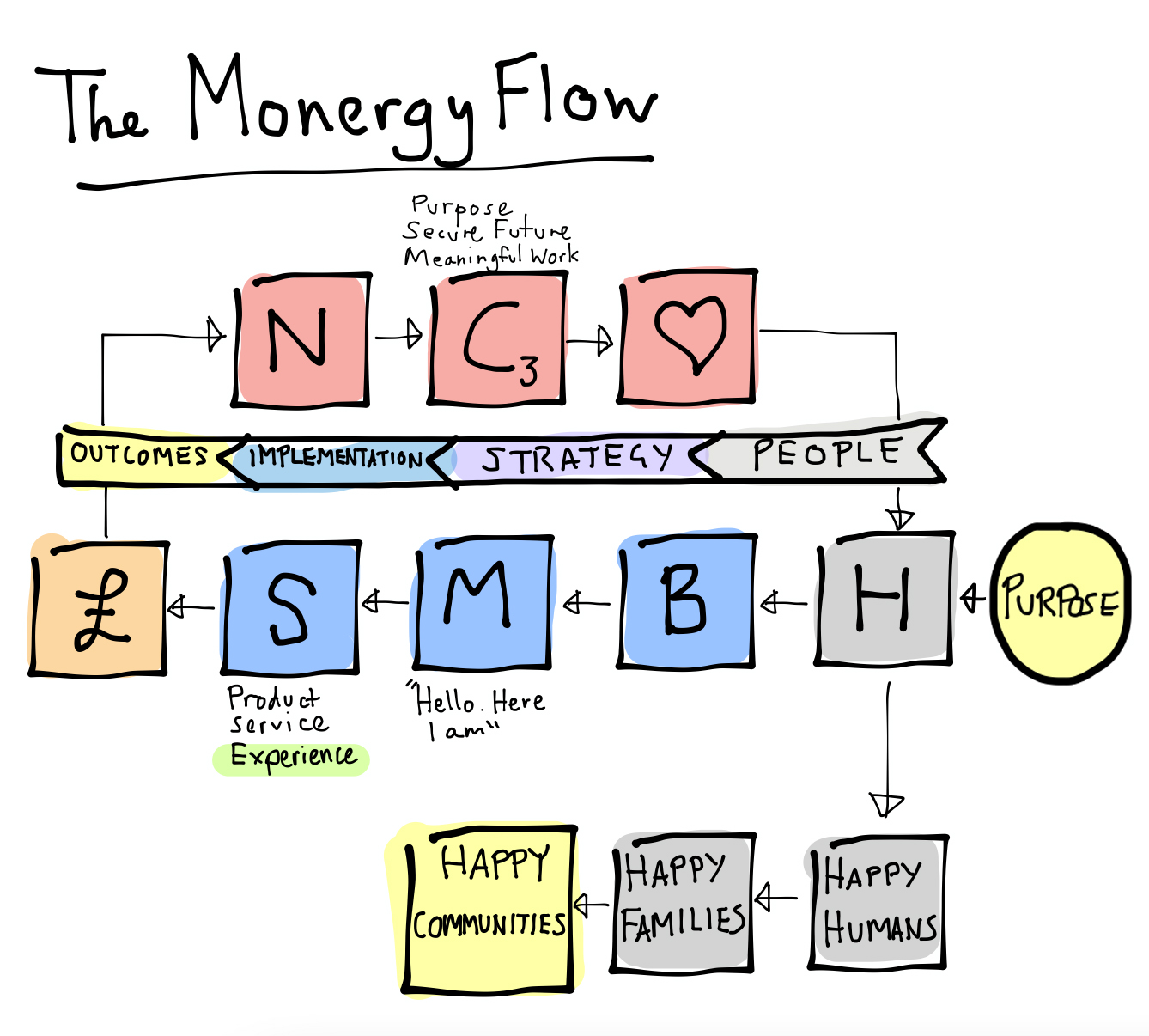
On one side, you’ve got money. Businesses need money to survive - there’s no getting around that. But money isn’t just about keeping the business alive. It pays salaries, fuels innovation and contributes to society through donations, which most people call taxes. And those donations? They fund the life we all expect - great schools, public spaces, infrastructure, healthcare and support for those who need it.
Now, it would be fantastic if money simply appeared when we wished for it, but business doesn’t work like that. To make money, you have to sell something. Traditionally, we’ve thought about this in terms of products or services, but when you look closer, what we’re really selling is experiences. Every product we buy offers us an experience - the way it feels to use, the problems it solves or the emotions it creates. The experience is often just as valuable as the thing itself.
But before you can sell anything, people need to know you exist. That’s where marketing comes in. Marketing, at its core, is simply letting people know you have something to offer. Let’s say I’m an accountant. I could put up a sign that says, “Hey, I’m a great accountant. Do you want to buy my services?” If I’m lucky, someone will say yes, and we’ve now got a transactional relationship - I provide accountancy services, and in exchange, I receive money. Simple enough.
But here’s the problem.
Think about the most meaningful relationships in your life - your best friends, your spouse, your closest colleagues. They aren’t transactional. You don’t stay in those relationships because you’re keeping score of what you get in return. They are built on shared values, mutual respect and a sense of belonging.
Now, back to my accounting example. What happens when another accountant comes along offering the same service for less? If our relationship is purely transactional, the client will switch. But if our relationship is based on shared values and trust, the bond is much stronger. A customer who feels aligned with you and what you stand for is far less likely to leave.
This is where most businesses go wrong. They focus on what they sell instead of who they are. Marketing isn’t about pushing a product or service. It’s about stepping forward and saying, “This is who we are. This is why we do what we do.”
It’s being able to say “Hello, here I am” genuinely and authentically.
When a business is clear about its values and purpose, the right people naturally gravitate toward it. Customers who resonate with those values will want to engage, buy and - most powerfully - recommend that business to others. The most successful businesses understand this and have cultivated their personalities - their brands. But here’s the key: it’s not the business itself that creates the brand. Remember, businesses don’t exist. It’s the humans behind it. The founders, the employees, the customers. Everything starts with the humans.
So, if you want to make more money, stop focusing on the money. Instead, focus on the humans - the people behind the business, the relationships they form and the shared purpose that brings them together. Everything flows from there.
The Upward Spiral: How Profits Should Flow
Once your business is running well and generating more money than it needs, what should you do with the profits? The best businesses reinvest. Not just in better technology or bigger offices, but in their people. They nurture their teams, strengthen relationships, create meaningful connections and love their people. And when people feel valued, engaged and part of something bigger than themselves, they perform better.
This isn’t just good leadership - it’s good business. When a business reinvests in its people, it strengthens the very foundation of the company. That leads to better ideas, better service and better experiences for customers. And that, in turn, leads to more revenue, more profits and even more investment in the business.
Round and round and up and up the cycle goes. I call this The Upward Spiral.
Nurtured Humans Are Happy Humans
A better-functioning, more profitable business isn’t the only outcome of this model. When people feel connected to their work, they feel happier. They feel like they belong - that their contributions matter and that they are part of something meaningful.
And when people are surrounded by colleagues they admire, respect and enjoy working with, something else happens. Work stops feeling like work. It becomes an energising, fulfilling part of life.
Happy Humans Go Home
The impact of a positive work environment doesn’t stay at the office. People don’t just leave their emotions at the door when they head home. A stressed, burned-out employee doesn’t just suffer at work - they bring that energy home to their families. Tension at work creates tension at home. Frustration in the office leads to frustration in relationships. But the reverse is also true. When people leave work feeling valued, fulfilled and appreciated, they take that positive energy home with them.
They are more patient parents, more supportive partners and more engaged members of their communities.
Happy Communities
When families thrive, neighbourhoods thrive. When neighbourhoods thrive, communities thrive. And when communities thrive, society as a whole benefits.
This is the ripple effect of business done right.
The old way of thinking told us that business was separate from society. That companies existed to maximise profits, and everything else was someone else’s responsibility - government, education, healthcare. But that’s simply not true. Business is society. The choices we make as business leaders shape the world we live in.
The Monergy Flow model shows that financial success and human well-being aren’t opposing forces. They fuel each other. Businesses that invest in relationships, culture and purpose make more money in the long run. They retain better employees, attract more loyal customers and create lasting impact.
When we get this right, we don’t just build better businesses. We build a better world.
Conclusion
Happier communities are not someone else’s responsibility. It is all too easy to point a finger at governments or schools and suggest that they need to do something to fix these social issues. And yes, they have their part to play, but so do we.
As humans, we must refuse to absolve ourselves of the part we play in building the society in which we live and the legacy we leave behind.
We call it responsibility, but really, it’s our privilege.